Author: Matthew Giggengrove

  • How Much Should a Local Business Spend on Google Ads?

    How Much Should a Local Business Spend on Google Ads?

    One of the most common questions local business owners ask is simple:

    “How much should I spend on Google Ads?”

    The honest answer is: it depends on your market, your goals, your competition, and how much a new customer is worth to your business.

    That may not sound as clean as “spend $500” or “spend $3,000,” but it is the right way to think about it. A local business Google Ads budget should not be picked randomly. It should be built around what you are trying to accomplish.

    Are you trying to get more phone calls? More quote requests? More booked appointments? More walk-in customers? More high-value leads?

    The right Google Ads budget is not just about how much you can afford to spend. It is about how much you can spend without wasting money and how quickly you want to learn what works.

    A Good Starting Range for Local Business Google Ads
    Google Ads budget ranges for small businesses from testing to growth

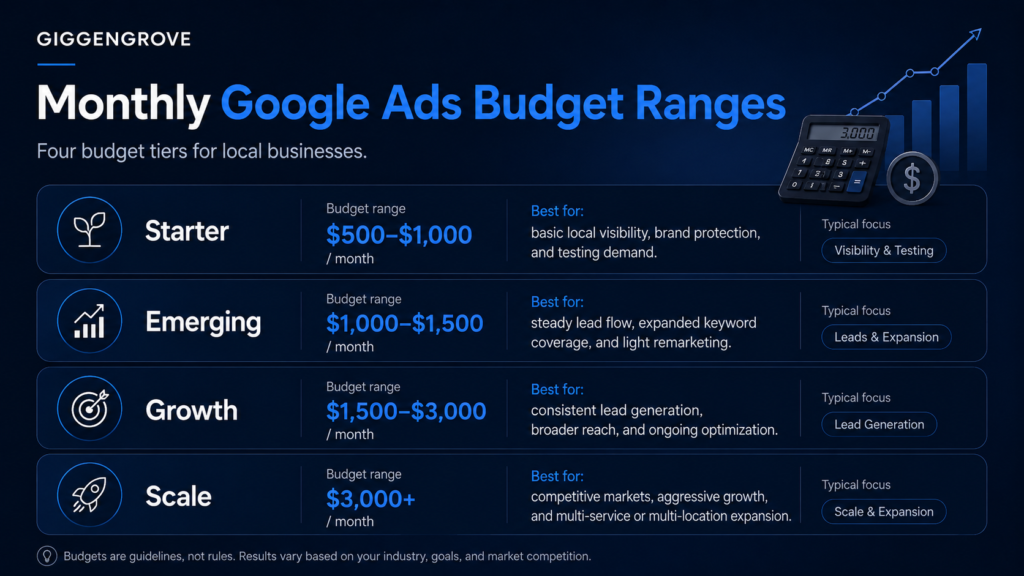
    For many local businesses, a realistic starting Google Ads budget usually falls into one of these ranges:

    Monthly Google Ads BudgetBest For
    $500–$1,000/monthTesting the market, very small local campaigns, limited keyword coverage
    $1,500–$3,000/monthMore serious local lead generation, better data, stronger optimization
    $3,000–$5,000+/monthCompetitive markets, multiple services, larger service areas, faster growth
    $5,000–$10,000+/monthAggressive growth, high-value services, multi-location or high-competition campaigns

    For most small businesses, I usually view $1,500 to $3,000 per month as a practical starting point if the goal is to generate enough traffic and lead data to make smart decisions.

    You can technically run Google Ads with less, but there is a difference between “running ads” and running ads with enough budget to learn, optimize, and improve performance.

    Why Small Budgets Can Be Hard to Learn From
    Comparison of small and larger Google Ads budgets based on clicks and leads

    A small budget is not automatically bad. In some cases, starting small is the right move.

    The issue is that Google Ads needs enough data to show you what is actually happening. If your budget only produces a small number of clicks each month, it becomes harder to know whether the campaign is working or if you simply do not have enough volume yet.

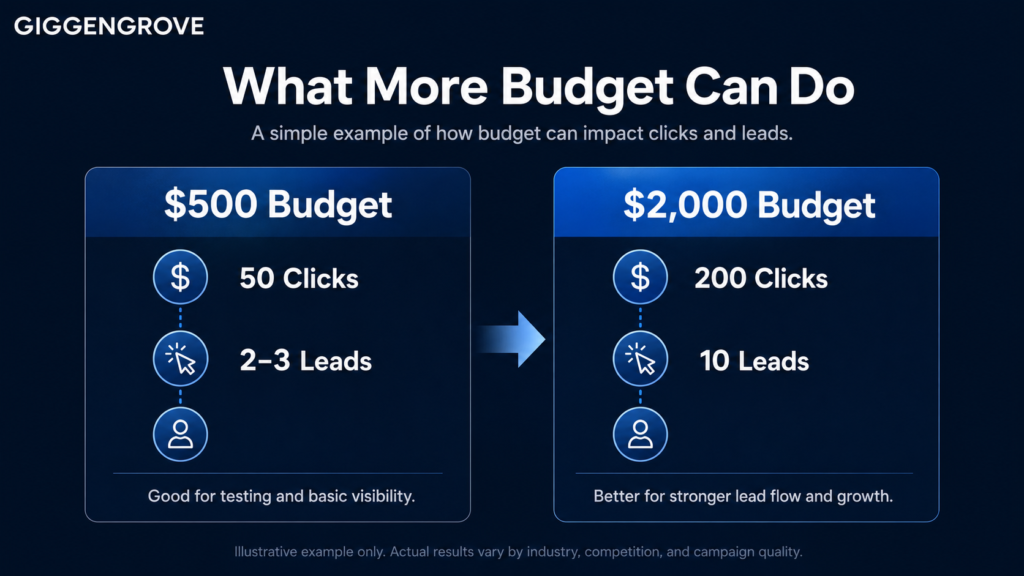
    For example, let’s say your average cost-per-click is $10.

    A $500 monthly budget gets you roughly 50 clicks.

    If your website converts 5% of visitors into leads, that is around 2 to 3 leads per month. That may not be enough data to confidently judge the campaign, the keywords, the ads, or the landing page.

    Now compare that with a $2,000 monthly budget.

    At the same $10 cost-per-click, that gives you roughly 200 clicks. With a 5% conversion rate, that could generate around 10 leads. That gives you much more useful information to work with.

    The point is not that every business needs to spend $2,000. The point is that your budget should be large enough to produce meaningful activity.

    The Right Question Is Not “What Does Google Ads Cost?”

    A better question is:

    “How much can I afford to pay for a qualified lead or new customer?”

    That changes the conversation.

    If you are a local restaurant, a single new customer may be worth $25 to $75 on the first visit. If you are a contractor, sign company, lawyer, dentist, med spa, HVAC company, or other service business, one new customer could be worth hundreds or thousands of dollars.

    That difference matters.

    A $75 lead might be expensive for one business and extremely profitable for another.

    This is why the Google Ads cost for small business can vary so much. The ad platform is only one part of the equation. Your industry, offer, location, sales process, close rate, and customer value all matter.

    A Simple Formula for Planning Your Google Ads Budget
    Google Ads budget formula using lead goal and target cost per lead

    Here is a practical way to estimate how much to spend on Google Ads:

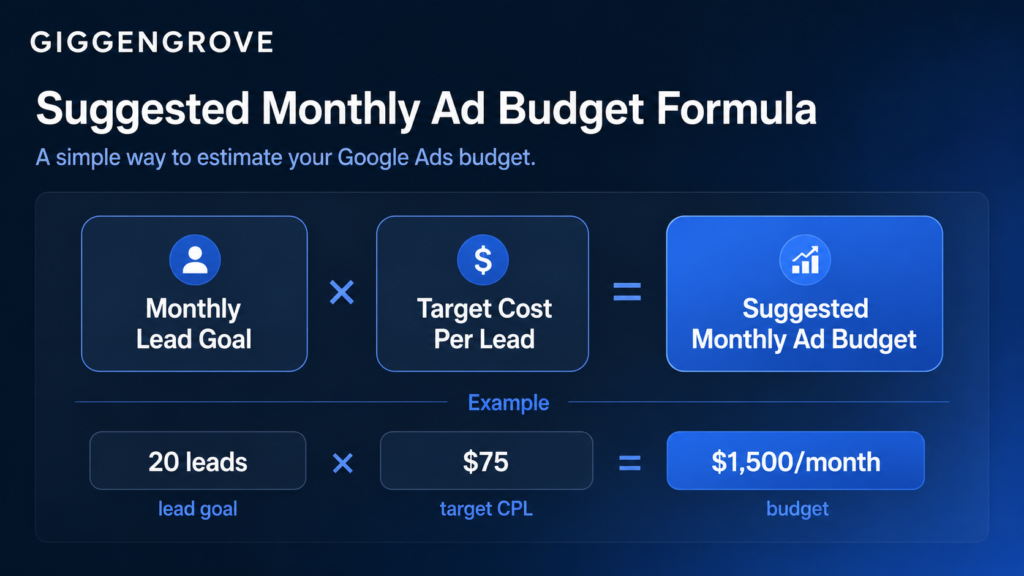
    Monthly Lead Goal × Target Cost Per Lead = Suggested Monthly Ad Budget

    For example:

    If you want 20 leads per month and you believe a reasonable target cost per lead is $75, then:

    20 leads × $75 = $1,500/month

    If you want 40 leads per month at the same cost per lead:

    40 leads × $75 = $3,000/month

    This is a simple model, but it helps business owners think about budget in a more useful way.

    Instead of saying, “I want to spend as little as possible,” you can say:

    “I want to generate enough qualified leads at a cost that makes sense for my margins.”

    That is a much healthier way to approach paid advertising.

    What Impacts How Much You Need to Spend?
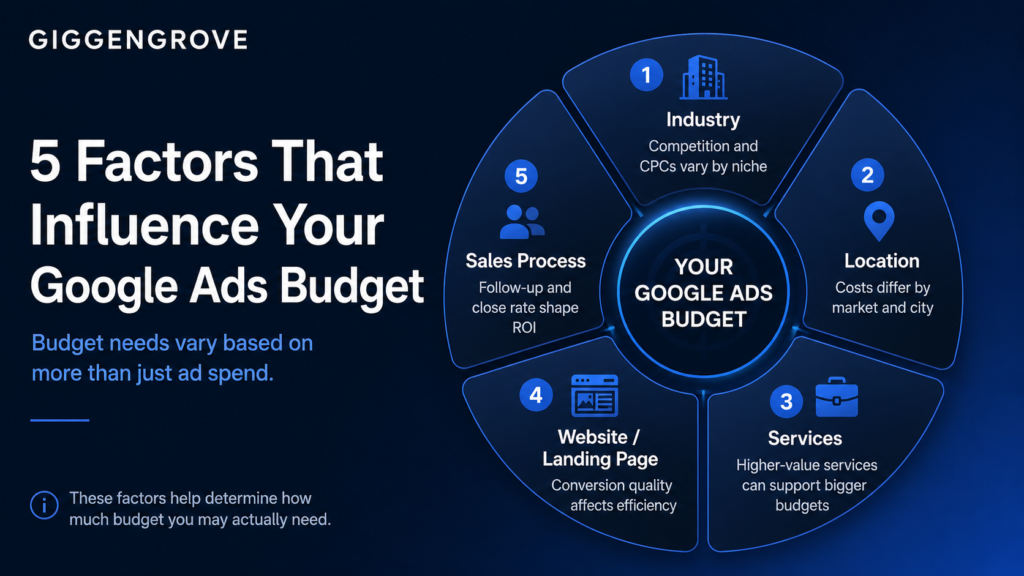
    Key factors that impact how much a local business should spend on Google Ads

    There is no universal answer for how much to spend on Google Ads because several factors affect your budget.

    1. Your Industry

    Some industries are more competitive than others. Legal, home services, insurance, medical, construction, and high-value B2B services often have higher click costs because one new customer can be worth a lot of money.

    If many businesses are willing to pay for the same lead, the cost goes up.

    2. Your Location

    A business advertising in a dense or competitive New Jersey market may need a different budget than a business in a smaller town with less competition.

    Local advertising budget planning should always account for the actual service area. Advertising across all of New Jersey is very different from advertising within a 10-mile radius of Hillsborough, Princeton, Cherry Hill, Hoboken, or Edgewater Park.

    The larger the area, the more budget you may need.

    3. Your Services

    A business with one core service may be able to run a focused campaign with a smaller budget.

    A business with multiple services may need separate campaigns or ad groups for each major offering. That usually requires more budget because you are spreading spend across more search terms.

    For example, a sign company may want to advertise for:

    • Custom business signs
    • Channel letter signs
    • Monument signs
    • Exterior lighted signs
    • Carved signs
    • Commercial awnings

    Each service may have different search volume, competition, and lead value.

    4. Your Website or Landing Page

    Google Ads can bring people to your site, but your website still has to convert them.

    If your site is slow, confusing, outdated, or missing clear calls-to-action, your ad budget will not work as hard as it should.

    Before increasing spend, I always like to look at the basics:

    • Is the phone number easy to find?
    • Is there a strong contact form?
    • Does the page explain the service clearly?
    • Are there trust signals, photos, testimonials, or examples?
    • Does the page match what the person searched for?

    A better landing page can make the same ad budget perform better.

    5. Your Sales Process

    Google Ads does not end when someone fills out a form.

    If leads are not followed up with quickly, if calls are missed, or if quote requests sit for days, the campaign may look worse than it actually is.

    Sometimes the issue is not the ads. It is the follow-up process.

    That is why I like looking at the full path:

    Search → Click → Website → Call/Form → Follow-Up → Sale

    The budget matters, but the process around the budget matters too.

    How Google Ads Budgets Actually Work

    Google Ads usually asks you to set an average daily budget. That daily number is then used to pace spend across the month.

    For example, if you want to spend around $1,500 per month, your daily budget would be roughly:

    $1,500 ÷ 30.4 = about $49/day

    Google may spend more on some days and less on others depending on search demand, but the monthly budget is still managed around that daily average.

    So when a business owner says, “I want to spend $1,500 per month,” that usually becomes a daily budget of about $49 in Google Ads.

    What Is a Good Starter Budget?

    If you are a local business starting Google Ads for the first time, I would usually think about budget in three stages.

    Stage 1: Test Budget

    A test budget is usually around $500 to $1,000 per month.

    This can work if you have a small service area, limited competition, or just want to get a feel for search demand.

    The downside is that it may take longer to collect useful data.

    Stage 2: Learning Budget

    A stronger learning budget is usually around $1,500 to $3,000 per month.

    This is where many local businesses can start to get a better read on what keywords, ads, and landing pages are producing results.

    You are not spending aggressively yet, but you are giving the campaign enough room to breathe.

    Stage 3: Growth Budget

    A growth budget is usually $3,000+ per month, depending on the business.

    This makes more sense when you already know Google Ads can produce qualified leads and you want to increase volume.

    At this stage, the focus becomes scaling what works while cutting what does not.

    Do Not Spend More Until Tracking Is Set Up
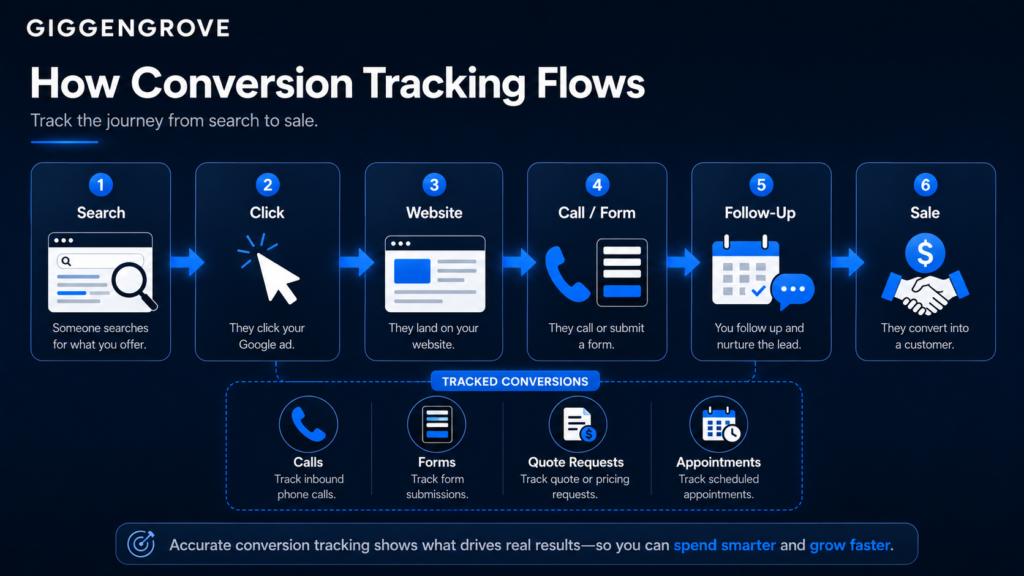
    Google Ads conversion tracking flow from search click to local business lead

    Before increasing any Google Ads budget, make sure conversion tracking is in place.

    At minimum, you should be tracking:

    • Form submissions
    • Phone calls from ads
    • Phone calls from the website
    • Quote requests
    • Booked appointments
    • Key website actions

    Without tracking, you are mostly guessing.

    You may know that business picked up, but you will not know which keywords, ads, or campaigns helped create that growth.

    That is where a lot of small businesses waste money. They spend on ads, but they do not have a clear enough view of what is actually driving calls, quotes, and customers.

    Should You Spend More on Ads or Management?

    This is an important question.

    A local business should not spend so much on management that there is not enough money left for the actual media budget.

    For example, if your total monthly budget is $1,000, you probably do not want $800 going to management and only $200 going into Google Ads. There would not be enough ad spend to generate meaningful results.

    A practical approach is to think about two separate numbers:

    1. Media budget: The money paid directly to Google for ads
    2. Management budget: The money paid to set up, manage, optimize, and report on the campaigns

    Both matter.

    The media budget gets you visibility. The management makes sure the budget is being used intelligently.

    My Practical Recommendation

    If you are a local business and you are serious about testing Google Ads, I would usually recommend starting with a monthly ad budget that is high enough to answer three questions:

    1. Are people searching for what you offer?
    2. Can we get qualified traffic at a reasonable cost?
    3. Can the website turn that traffic into calls, forms, quotes, or appointments?

    For many local businesses, that means starting around $1,500 to $3,000 per month in ad spend for at least a few months.

    That does not mean every business needs to start there. Some can start smaller. Some competitive businesses may need more.

    But if the budget is too small, the campaign may never get enough data to prove what is working.

    Common Mistakes Local Businesses Make With Google Ads Budgets

    Mistake 1: Starting Too Broad

    Many businesses try to advertise every service to every location right away.

    That spreads the budget too thin.

    It is usually better to start with your highest-value services and strongest local areas first.

    Mistake 2: Chasing Cheap Clicks

    Cheap clicks are not always good clicks.

    A $2 click that never turns into a lead is not better than a $12 click from someone ready to request a quote.

    Focus on qualified traffic, not just cheap traffic.

    Mistake 3: Sending All Traffic to the Homepage

    Your homepage may be fine, but it is not always the best landing page for every ad.

    If someone searches for “custom monument signs in NJ,” they should land on a page that clearly talks about monument signs, not a generic homepage where they have to figure it out themselves.

    Mistake 4: Judging Too Quickly

    Google Ads needs time to gather data.

    You should not ignore bad performance, but you also should not panic after a few days.

    The first phase of a campaign is often about learning: which keywords are too broad, which searches are irrelevant, which ads get engagement, and which pages convert best.

    Mistake 5: Not Reviewing Search Terms

    Search terms show what people actually typed before clicking your ad.

    This is one of the most important areas to review because it helps you find wasted spend and add negative keywords.

    If you are not reviewing search terms, you may be paying for clicks that are not relevant to your business.

    So, How Much Should a Local Business Spend on Google Ads?

    A local business should spend enough on Google Ads to generate meaningful traffic, leads, and learning — but not so much that the budget becomes uncomfortable or disconnected from profitability.

    As a general rule:

    • $500–$1,000/month can work for a small test.
    • $1,500–$3,000/month is a stronger starting range for serious local lead generation.
    • $3,000+/month makes sense when the market is competitive or you are ready to scale.
    • $5,000+/month may be needed for larger service areas, high-value industries, or aggressive growth goals.

    The best budget is not the biggest budget.

    The best budget is the one tied to a clear goal, a realistic cost-per-lead target, proper tracking, and a plan to keep improving.

    Need Help Planning a Google Ads Budget?

    If you are trying to figure out how much to spend on Google Ads, the first step is not launching a campaign.

    The first step is building a practical plan.

    At Giggengrove Marketing Services, I help local and small businesses create clearer, more measurable marketing across Google Ads, local visibility, content, and reporting.

    If you are looking for NJ Google Ads management or simply want a second opinion on your current local advertising budget, I can help review what you are spending, where the money is going, and what could be improved.

    Want a clearer plan for your Google Ads budget? Reach out for a practical marketing review.


    FAQ

    How much should a small business spend on Google Ads?

    Many small businesses start with $500 to $1,000 per month for a basic test, but $1,500 to $3,000 per month is often a stronger range if the goal is to generate enough traffic and lead data to optimize properly.

    Is $500 per month enough for Google Ads?

    It can be enough to test, but it may not produce enough clicks or leads to make fast decisions. A smaller budget usually means a slower learning process.

    What is a good Google Ads budget for a local service business?

    A good starting budget for a local service business is often $1,500 to $3,000 per month, depending on the service area, competition, cost-per-click, and value of each new customer.

    How do I know if my Google Ads budget is working?

    Your budget is working if it is generating qualified leads at a cost that makes sense for your business. You should track calls, forms, quote requests, booked appointments, and actual sales whenever possible.

    Should I increase my Google Ads budget?

    You should consider increasing your budget when your campaign is generating qualified leads, conversion tracking is working, and you have confidence that additional spend can produce additional profitable opportunities.
  • What Should a Small Business Marketing Strategy Actually Include?

    What Should a Small Business Marketing Strategy Actually Include?


    A small business marketing strategy should include more than just posting on Facebook, running a few Google Ads, or updating your website once in a while.

    A strong marketing strategy gives your business a clear plan for how to attract the right customers, communicate your value, generate leads, measure performance, and grow over time.

    For many small businesses, the problem is not a lack of effort. It is a lack of structure.

    You may already have a website, a Google Business Profile, a Facebook page, some paid ads, or a few blog posts. But if those pieces are not working together, it becomes difficult to know what is actually helping your business grow.

    That is where a practical small business marketing strategy comes in.

    At Giggengrove Marketing, the goal is simple: help small businesses build marketing that is clear, manageable, measurable, and designed to drive real business outcomes.


    What Is a Small Business Marketing Strategy?

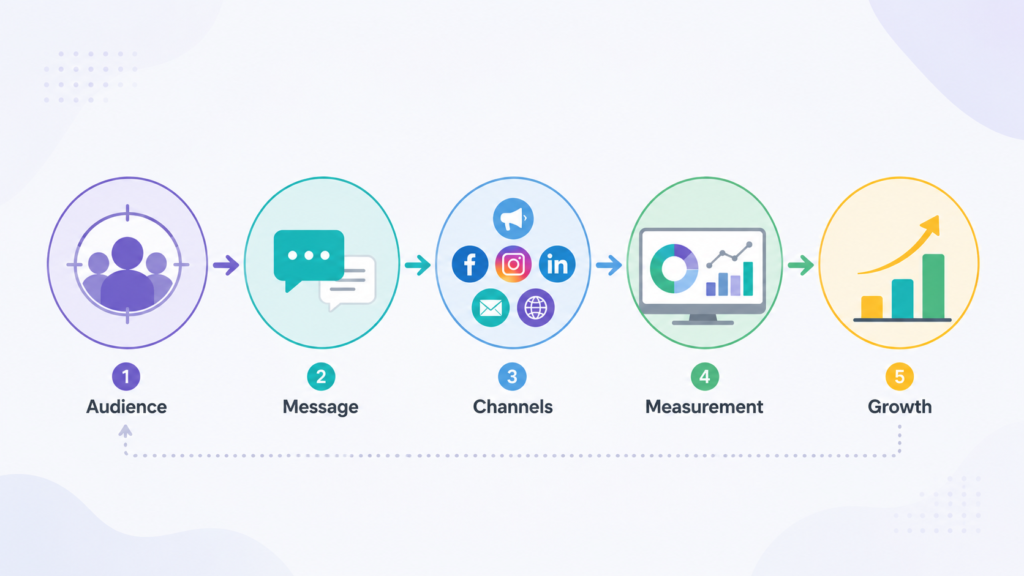
    Small business marketing strategy framework for audience messaging channels and growth

    A small business marketing strategy is a clear plan for how your business will reach potential customers, explain what makes you valuable, and convert attention into leads, calls, visits, sales, or booked services.

    It should answer a few key questions:

    • Who are you trying to reach?
    • What problem do you solve?
    • Why should someone choose your business instead of a competitor?
    • Which marketing channels should you focus on?
    • What content or messaging should you use?
    • How will you measure whether your marketing is working?

    A good strategy does not need to be overly complicated. In fact, for most local businesses, simpler is usually better.

    The best marketing strategy is one your business can actually execute consistently.


    1. A Clear Understanding of Your Ideal Customer

    Every strong small business marketing plan starts with knowing who you are trying to reach.

    This does not mean you need a 20-page customer persona document. But you should clearly understand your ideal customer’s needs, concerns, motivations, and decision-making process.

    For example, a local service business may want to know:

    • Is the customer a homeowner, business owner, parent, contractor, or office manager?
    • Are they looking for speed, quality, price, trust, convenience, or expertise?
    • Are they comparing multiple local businesses?
    • Are they searching on Google, asking for referrals, or browsing social media?
    • What would make them feel confident enough to call, request a quote, or book a service?

    When you understand the customer, your marketing becomes much sharper.

    Instead of saying, “We offer great service,” you can say something more specific, like, “Fast, reliable service for local homeowners who need the job done right the first time.”

    That type of messaging is more useful, more memorable, and more likely to convert.


    2. A Strong Value Proposition

    Your value proposition is the simple answer to this question:

    Why should someone choose your business?

    Many small businesses struggle here because they are too close to their own work. They know they are good, but they do not always explain it clearly to customers.

    A strong value proposition should highlight what makes your business different or better. This could include:

    • Years of experience
    • Local expertise
    • Better customer service
    • Faster turnaround times
    • Higher-quality materials
    • More transparent pricing
    • Specialized services
    • Family-owned or community-focused positioning
    • Proven results or customer reviews

    For a local business, your value proposition should be visible across your website, Google Business Profile, social media pages, ads, and sales materials.

    Your marketing should not make customers work hard to understand why you are the right choice.


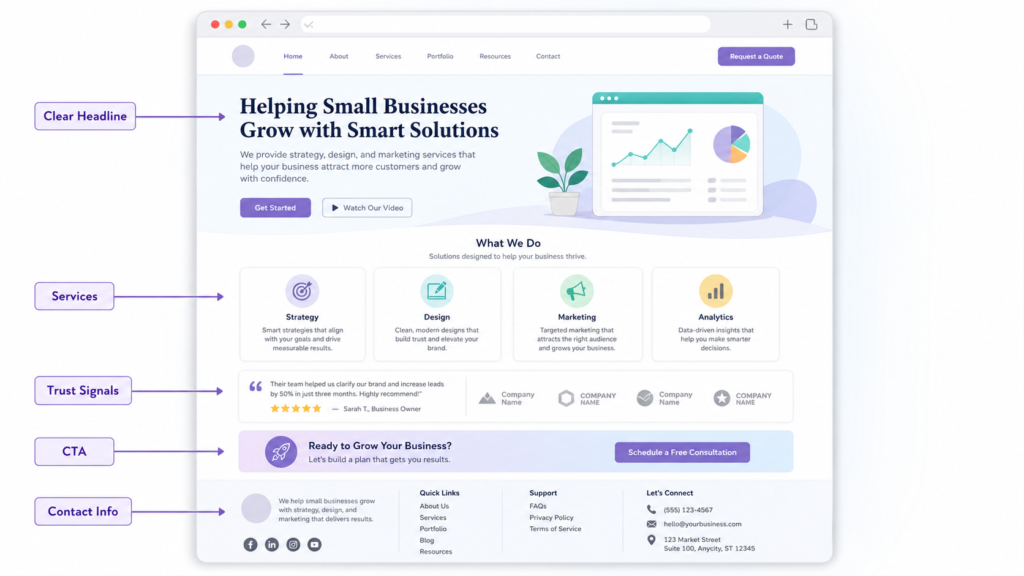
    3. A Website That Supports Business Growth

    Small business website strategy with clear calls to action and trust signals

    Your website is often the center of your marketing strategy. Even if someone finds you through Google, Facebook, Instagram, a referral, or a paid ad, they will often visit your website before contacting you.

    A strong small business website should clearly explain:

    • Who you are
    • What services or products you offer
    • Where you operate
    • Why customers should trust you
    • How someone can contact you
    • What action they should take next

    For local businesses, your website should also support local search visibility. That means having service pages, location references, clear contact information, and content that matches what customers are searching for.

    Your website does not need to be fancy. But it does need to be clear, credible, mobile-friendly, and built around conversion.

    A good website should help turn visitors into calls, quote requests, appointments, purchases, or inquiries.


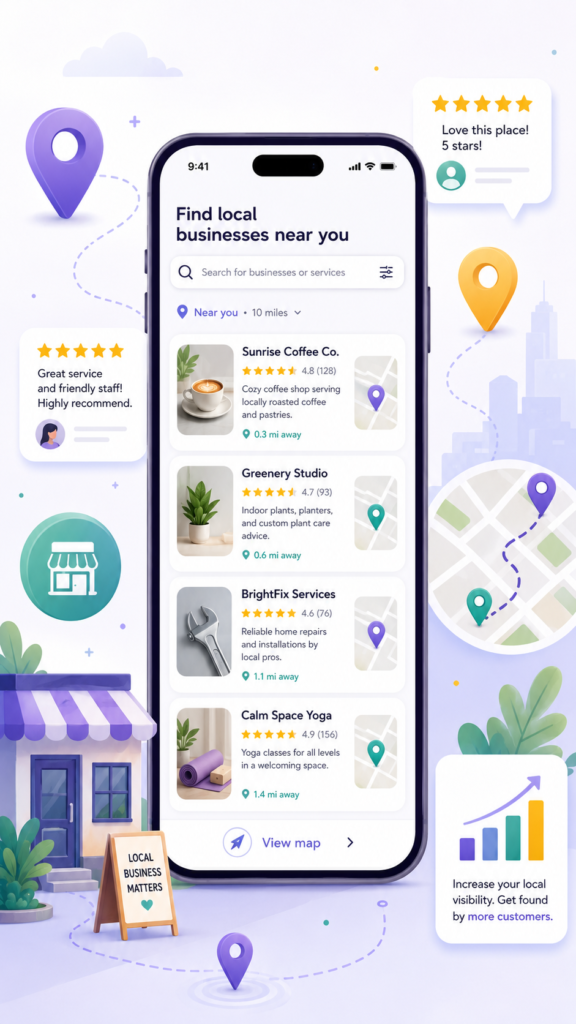
    4. Local SEO and Google Business Profile Optimization

    Local SEO strategy for small businesses using Google Business Profile and local search

    For many small businesses, especially in New Jersey and other competitive local markets, local SEO is one of the most important parts of a marketing strategy.

    Local SEO helps your business appear when people search for products or services near them.

    Examples include searches like:

    • “marketing consultant NJ”
    • “sign company near me”
    • “local plumber in Burlington County”
    • “best landscaper near Edgewater Park”
    • “small business marketing help in New Jersey”

    Your Google Business Profile is a key part of this. It can help your business appear in Google Maps, local search results, and “near me” searches.

    A strong local marketing strategy should include:

    • Accurate business information
    • Service categories
    • Photos
    • Reviews
    • Google Business Profile posts
    • Local keywords
    • Service-area information
    • Website links
    • Consistent business listings across the web

    For many small businesses, improving local visibility can directly increase calls, visits, and leads.


    5. Paid Media That Supports the Right Goals

    Paid media can be extremely valuable for small businesses, but only when it is managed with a clear strategy.

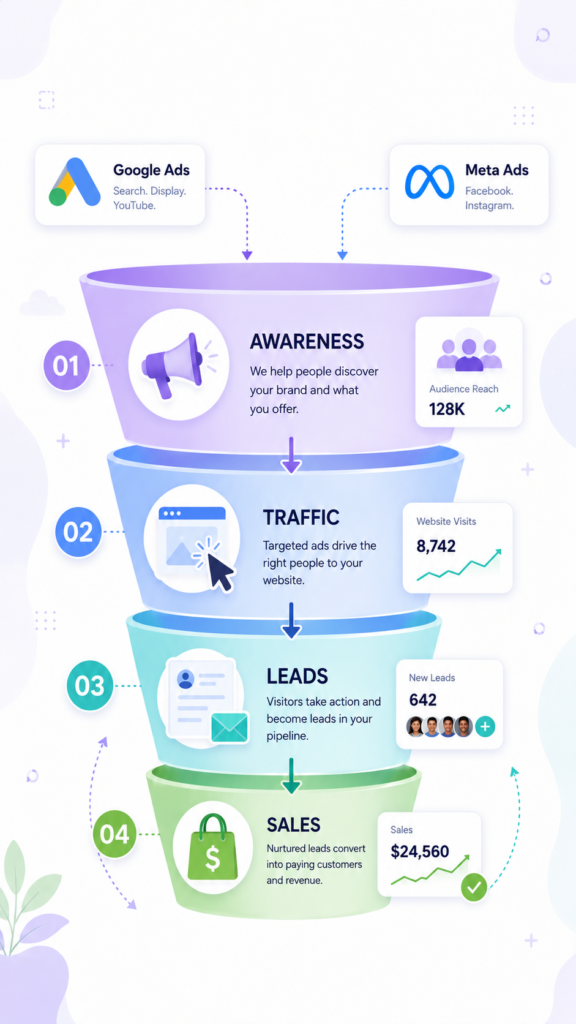
    This can include:

    Paid media strategy for small business Google Ads Meta Ads leads and sales funnel
    • Google Ads
    • Meta Ads
    • Facebook Ads
    • Instagram Ads
    • LinkedIn Ads
    • Local service ads
    • Retargeting campaigns

    The biggest mistake small businesses make with paid media is running campaigns without a clear goal.

    Before spending money, you should know what you want the campaign to accomplish.

    Are you trying to generate phone calls? Quote requests? Website visits? Store visits? Online purchases? Awareness in a local market?

    A practical paid media strategy should define:

    • Campaign objective
    • Target audience
    • Budget
    • Geography
    • Keywords or targeting
    • Ad messaging
    • Landing page
    • Conversion tracking
    • Reporting cadence
    • Optimization plan

    Paid advertising should not feel like guessing. It should be measured, adjusted, and improved over time.


    6. Consistent Owned Media

    Owned media includes the channels your business controls, such as your website, blog, email list, Google Business Profile, and social media pages.

    For a small business, owned media is important because it builds credibility over time.

    This could include:

    • Blog posts
    • Service pages
    • Case studies
    • Customer stories
    • Social media updates
    • Email newsletters
    • Educational content
    • Project photos
    • Before-and-after examples
    • FAQs

    The goal is not to post just for the sake of posting. The goal is to create content that supports your business.

    For example, a local business may use blog content to answer common customer questions, improve SEO, and build trust before someone reaches out.

    A helpful blog post can work for your business long after it is published.


    7. Clear Branding and Messaging

    Branding is not just your logo, colors, or business name. Those things matter, but branding is really about how people understand and remember your business.

    Your brand should communicate:

    • What you do
    • Who you help
    • What you stand for
    • Why you are different
    • What kind of experience customers can expect

    For small businesses, branding should be practical. It should make your business easier to recognize, trust, and choose.

    That means your messaging should be consistent across your website, ads, social media, Google Business Profile, sales materials, and customer communications.

    If your website says one thing, your ads say another, and your social media has a completely different tone, your marketing can feel disconnected.

    A strong brand creates consistency.

    Consistency creates trust.

    Trust helps drive business.


    8. A Social Media Plan That Makes Sense for Your Business

    Not every small business needs to be on every social media platform.

    A good social media strategy should be realistic and based on where your customers actually spend time.

    For many local businesses, Facebook and Instagram can be useful for visibility, community engagement, reviews, project photos, and updates. For B2B companies, LinkedIn may be more valuable. For visually driven businesses, Instagram, Pinterest, or TikTok may play a bigger role.

    Your social media plan should define:

    • Which platforms matter most
    • How often you should post
    • What types of content you should share
    • Who is responsible for posting
    • How social media supports your broader marketing goals

    Good social media content may include customer education, project examples, team updates, promotions, helpful tips, community involvement, and behind-the-scenes content.

    Social media should support your brand, not become a random collection of posts.


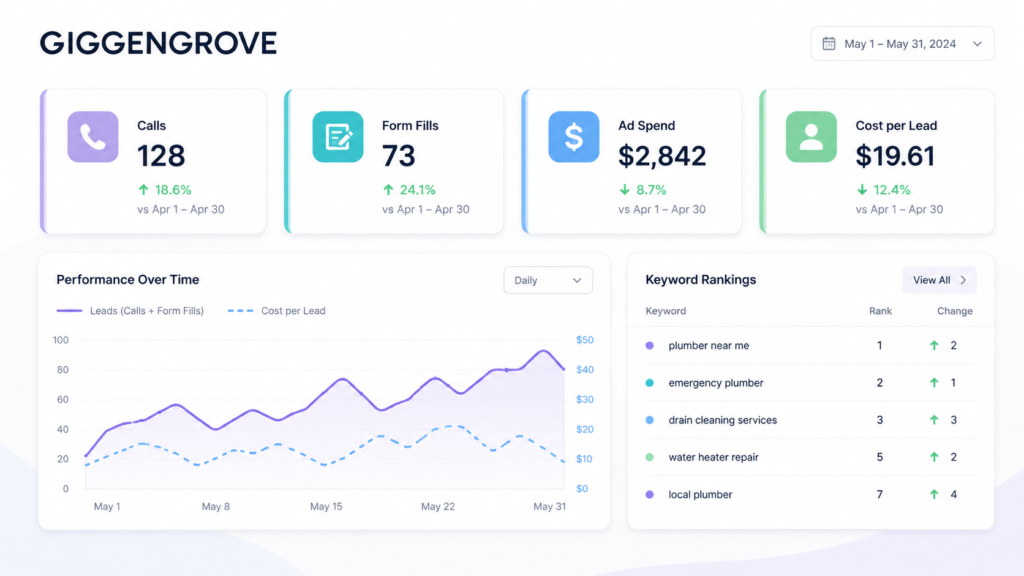
    9. Reporting and Performance Tracking

    Small business marketing reporting dashboard tracking calls leads ad spend and keyword rankings

    A marketing strategy is incomplete without reporting.

    If you are investing time or money into marketing, you should know what is working.

    That does not mean you need to track every possible metric. Small businesses should focus on the numbers that actually connect to business growth.

    Important metrics may include:

    • Website traffic
    • Phone calls
    • Contact form submissions
    • Quote requests
    • Booked appointments
    • Google Business Profile interactions
    • Ad spend
    • Cost per lead
    • Conversion rate
    • Keyword rankings
    • Social media engagement
    • Email performance
    • Revenue influenced by marketing

    Reporting should help you make decisions.

    For example, if Google Ads is driving calls at a strong cost per lead, you may want to increase investment. If a blog post is ranking well and bringing in traffic, you may want to build more content around that topic. If a social media platform is getting no engagement, you may need to adjust the content or shift focus.

    Marketing should improve over time. Reporting is how you know what to improve.


    10. A Practical Action Plan

    The final part of a small business marketing strategy is execution.

    A strategy is only valuable if it turns into action.

    Your plan should include:

    • What needs to be done
    • Who is responsible
    • How often it will happen
    • What the priority level is
    • How success will be measured

    For a small business, this may look like:

    • Publish one blog post per week
    • Post on Facebook two to three times per week
    • Update Google Business Profile weekly
    • Review Google Ads performance weekly
    • Review reporting monthly
    • Add new website service pages quarterly
    • Request new customer reviews consistently
    • Refresh ad creative every few months

    You do not need to do everything at once. The key is to create a realistic system that builds momentum.


    What Most Small Businesses Get Wrong About Marketing Strategy

    Many small businesses treat marketing as a list of disconnected tasks.

    They may run ads, post on social media, update their website, send emails, and ask for reviews — but without a clear connection between those efforts.

    The better approach is to make sure every marketing activity supports the same larger goal.

    Your website should support your ads.
    Your blog should support your SEO.
    Your social media should support your brand.
    Your Google Business Profile should support local visibility.
    Your reporting should support smarter decisions.

    When everything works together, your marketing becomes more efficient and easier to manage.


    A Simple Small Business Marketing Strategy Framework

    A strong small business marketing strategy can usually be organized into four main areas:

    Branding

    Your positioning, messaging, value proposition, visual identity, and customer trust signals.

    Paid Media

    Your Google Ads, Meta Ads, Facebook Ads, Instagram Ads, LinkedIn Ads, and other paid campaigns.

    Owned Media

    Your website, blog, Google Business Profile, email list, and organic social content.

    Reporting

    Your performance tracking, insights, recommendations, and ongoing optimization plan.

    This framework keeps marketing simple while still covering the most important areas for growth.


    How Giggengrove Helps Small Businesses

    Giggengrove helps small businesses create practical marketing strategies that are clear, focused, and built for real-world execution.

    That can include support with:

    • Small business marketing strategy
    • Local business marketing planning
    • Google Ads management
    • Meta (Facebook & Instagram) Ads management
    • Website content strategy
    • Blog planning
    • Google Business Profile optimization
    • Social media planning
    • Brand positioning
    • Monthly reporting
    • Marketing consulting

    For New Jersey small businesses, Giggengrove can provide local marketing support with an understanding of the regional market. For businesses outside New Jersey, the same strategy-first approach can still help create structure, improve visibility, and support growth.

    The goal is not to overcomplicate marketing.

    The goal is to make it clearer, more consistent, and more effective.


    Final Thoughts

    A small business marketing strategy should include your audience, value proposition, website, local SEO, paid media, owned media, branding, social media, reporting, and a clear action plan.

    But most importantly, it should be usable.

    The best marketing strategy is not the longest document. It is the one that helps your business make better decisions, stay consistent, and generate measurable growth.

    For many small businesses, the opportunity is already there. The next step is organizing the marketing pieces into a system that works together.


    Frequently Asked Questions

    What should a small business marketing strategy include?

    A small business marketing strategy should include your target audience, value proposition, website strategy, local SEO plan, paid media approach, owned media plan, branding, social media strategy, reporting, and a clear action plan.

    How often should a small business update its marketing strategy?

    Most small businesses should review marketing performance monthly and update their broader strategy every quarter. This allows enough time to collect data while still making improvements throughout the year.

    Do small businesses need paid ads?

    Not every small business needs paid ads, but paid media can help generate faster visibility, traffic, calls, and leads. The key is making sure campaigns are properly targeted, tracked, and optimized.

    Is local SEO important for small businesses?

    Yes. Local SEO is especially important for businesses that serve customers in specific towns, counties, regions, or service areas. It can help your business appear in Google Search and Google Maps when potential customers are looking for services nearby.

    Why hire a marketing consultant for a small business?

    A marketing consultant can help organize your marketing efforts, identify missed opportunities, improve performance, and create a practical plan for growth. This can be especially helpful when a business is doing some marketing already but lacks a clear strategy.