
One of the most common questions local business owners ask is simple:
“How much should I spend on Google Ads?”
The honest answer is: it depends on your market, your goals, your competition, and how much a new customer is worth to your business.
That may not sound as clean as “spend $500” or “spend $3,000,” but it is the right way to think about it. A local business Google Ads budget should not be picked randomly. It should be built around what you are trying to accomplish.
Are you trying to get more phone calls? More quote requests? More booked appointments? More walk-in customers? More high-value leads?
The right Google Ads budget is not just about how much you can afford to spend. It is about how much you can spend without wasting money and how quickly you want to learn what works.
A Good Starting Range for Local Business Google Ads
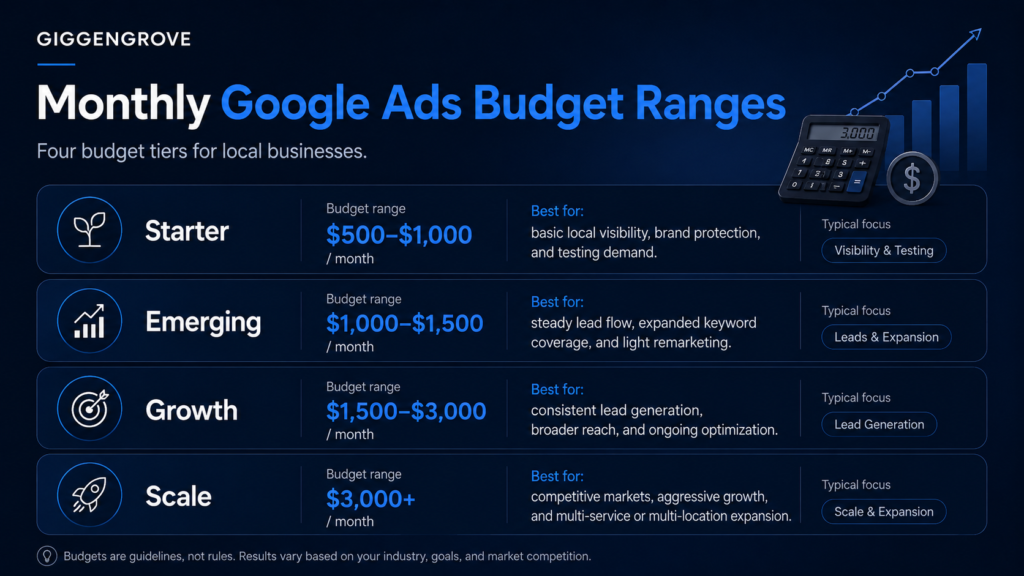
For many local businesses, a realistic starting Google Ads budget usually falls into one of these ranges:
| Monthly Google Ads Budget | Best For |
|---|---|
| $500–$1,000/month | Testing the market, very small local campaigns, limited keyword coverage |
| $1,500–$3,000/month | More serious local lead generation, better data, stronger optimization |
| $3,000–$5,000+/month | Competitive markets, multiple services, larger service areas, faster growth |
| $5,000–$10,000+/month | Aggressive growth, high-value services, multi-location or high-competition campaigns |
For most small businesses, I usually view $1,500 to $3,000 per month as a practical starting point if the goal is to generate enough traffic and lead data to make smart decisions.
You can technically run Google Ads with less, but there is a difference between “running ads” and running ads with enough budget to learn, optimize, and improve performance.
Why Small Budgets Can Be Hard to Learn From
A small budget is not automatically bad. In some cases, starting small is the right move.
The issue is that Google Ads needs enough data to show you what is actually happening. If your budget only produces a small number of clicks each month, it becomes harder to know whether the campaign is working or if you simply do not have enough volume yet.
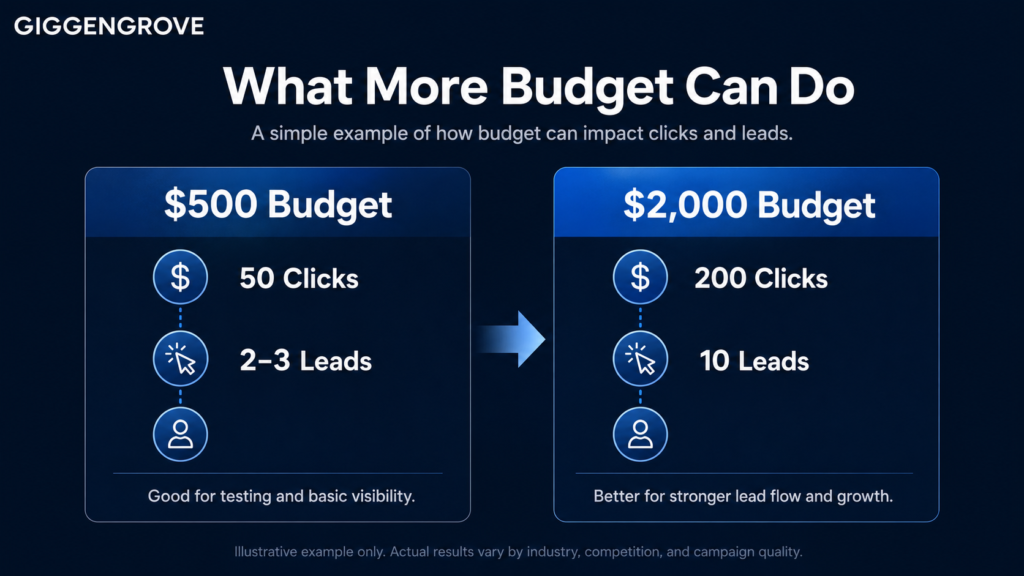
For example, let’s say your average cost-per-click is $10.
A $500 monthly budget gets you roughly 50 clicks.
If your website converts 5% of visitors into leads, that is around 2 to 3 leads per month. That may not be enough data to confidently judge the campaign, the keywords, the ads, or the landing page.
Now compare that with a $2,000 monthly budget.
At the same $10 cost-per-click, that gives you roughly 200 clicks. With a 5% conversion rate, that could generate around 10 leads. That gives you much more useful information to work with.
The point is not that every business needs to spend $2,000. The point is that your budget should be large enough to produce meaningful activity.
The Right Question Is Not “What Does Google Ads Cost?”
A better question is:
“How much can I afford to pay for a qualified lead or new customer?”
That changes the conversation.
If you are a local restaurant, a single new customer may be worth $25 to $75 on the first visit. If you are a contractor, sign company, lawyer, dentist, med spa, HVAC company, or other service business, one new customer could be worth hundreds or thousands of dollars.
That difference matters.
A $75 lead might be expensive for one business and extremely profitable for another.
This is why the Google Ads cost for small business can vary so much. The ad platform is only one part of the equation. Your industry, offer, location, sales process, close rate, and customer value all matter.
A Simple Formula for Planning Your Google Ads Budget
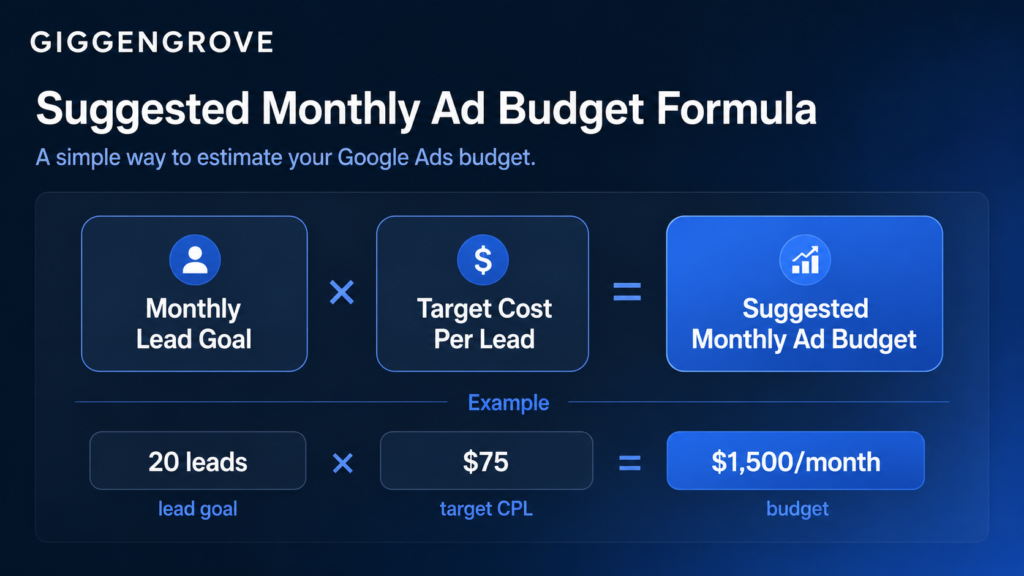
Here is a practical way to estimate how much to spend on Google Ads:
Monthly Lead Goal × Target Cost Per Lead = Suggested Monthly Ad Budget
For example:
If you want 20 leads per month and you believe a reasonable target cost per lead is $75, then:
20 leads × $75 = $1,500/month
If you want 40 leads per month at the same cost per lead:
40 leads × $75 = $3,000/month
This is a simple model, but it helps business owners think about budget in a more useful way.
Instead of saying, “I want to spend as little as possible,” you can say:
“I want to generate enough qualified leads at a cost that makes sense for my margins.”
That is a much healthier way to approach paid advertising.
What Impacts How Much You Need to Spend?
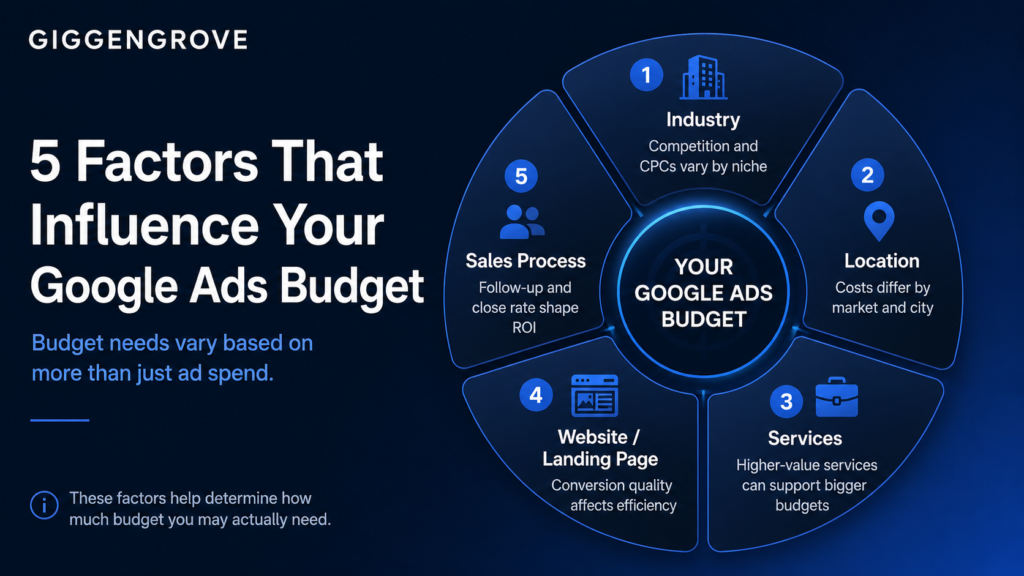
There is no universal answer for how much to spend on Google Ads because several factors affect your budget.
1. Your Industry
Some industries are more competitive than others. Legal, home services, insurance, medical, construction, and high-value B2B services often have higher click costs because one new customer can be worth a lot of money.
If many businesses are willing to pay for the same lead, the cost goes up.
2. Your Location
A business advertising in a dense or competitive New Jersey market may need a different budget than a business in a smaller town with less competition.
Local advertising budget planning should always account for the actual service area. Advertising across all of New Jersey is very different from advertising within a 10-mile radius of Hillsborough, Princeton, Cherry Hill, Hoboken, or Edgewater Park.
The larger the area, the more budget you may need.
3. Your Services
A business with one core service may be able to run a focused campaign with a smaller budget.
A business with multiple services may need separate campaigns or ad groups for each major offering. That usually requires more budget because you are spreading spend across more search terms.
For example, a sign company may want to advertise for:
- Custom business signs
- Channel letter signs
- Monument signs
- Exterior lighted signs
- Carved signs
- Commercial awnings
Each service may have different search volume, competition, and lead value.
4. Your Website or Landing Page
Google Ads can bring people to your site, but your website still has to convert them.
If your site is slow, confusing, outdated, or missing clear calls-to-action, your ad budget will not work as hard as it should.
Before increasing spend, I always like to look at the basics:
- Is the phone number easy to find?
- Is there a strong contact form?
- Does the page explain the service clearly?
- Are there trust signals, photos, testimonials, or examples?
- Does the page match what the person searched for?
A better landing page can make the same ad budget perform better.
5. Your Sales Process
Google Ads does not end when someone fills out a form.
If leads are not followed up with quickly, if calls are missed, or if quote requests sit for days, the campaign may look worse than it actually is.
Sometimes the issue is not the ads. It is the follow-up process.
That is why I like looking at the full path:
Search → Click → Website → Call/Form → Follow-Up → Sale
The budget matters, but the process around the budget matters too.
How Google Ads Budgets Actually Work
Google Ads usually asks you to set an average daily budget. That daily number is then used to pace spend across the month.
For example, if you want to spend around $1,500 per month, your daily budget would be roughly:
$1,500 ÷ 30.4 = about $49/day
Google may spend more on some days and less on others depending on search demand, but the monthly budget is still managed around that daily average.
So when a business owner says, “I want to spend $1,500 per month,” that usually becomes a daily budget of about $49 in Google Ads.
What Is a Good Starter Budget?
If you are a local business starting Google Ads for the first time, I would usually think about budget in three stages.
Stage 1: Test Budget
A test budget is usually around $500 to $1,000 per month.
This can work if you have a small service area, limited competition, or just want to get a feel for search demand.
The downside is that it may take longer to collect useful data.
Stage 2: Learning Budget
A stronger learning budget is usually around $1,500 to $3,000 per month.
This is where many local businesses can start to get a better read on what keywords, ads, and landing pages are producing results.
You are not spending aggressively yet, but you are giving the campaign enough room to breathe.
Stage 3: Growth Budget
A growth budget is usually $3,000+ per month, depending on the business.
This makes more sense when you already know Google Ads can produce qualified leads and you want to increase volume.
At this stage, the focus becomes scaling what works while cutting what does not.
Do Not Spend More Until Tracking Is Set Up
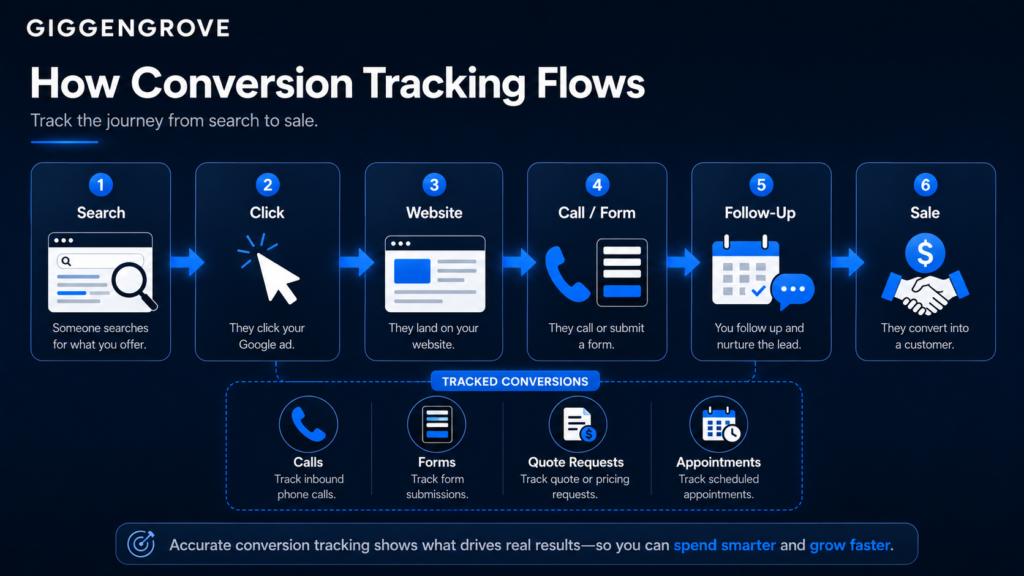
Before increasing any Google Ads budget, make sure conversion tracking is in place.
At minimum, you should be tracking:
- Form submissions
- Phone calls from ads
- Phone calls from the website
- Quote requests
- Booked appointments
- Key website actions
Without tracking, you are mostly guessing.
You may know that business picked up, but you will not know which keywords, ads, or campaigns helped create that growth.
That is where a lot of small businesses waste money. They spend on ads, but they do not have a clear enough view of what is actually driving calls, quotes, and customers.
Should You Spend More on Ads or Management?
This is an important question.
A local business should not spend so much on management that there is not enough money left for the actual media budget.
For example, if your total monthly budget is $1,000, you probably do not want $800 going to management and only $200 going into Google Ads. There would not be enough ad spend to generate meaningful results.
A practical approach is to think about two separate numbers:
- Media budget: The money paid directly to Google for ads
- Management budget: The money paid to set up, manage, optimize, and report on the campaigns
Both matter.
The media budget gets you visibility. The management makes sure the budget is being used intelligently.
My Practical Recommendation
If you are a local business and you are serious about testing Google Ads, I would usually recommend starting with a monthly ad budget that is high enough to answer three questions:
- Are people searching for what you offer?
- Can we get qualified traffic at a reasonable cost?
- Can the website turn that traffic into calls, forms, quotes, or appointments?
For many local businesses, that means starting around $1,500 to $3,000 per month in ad spend for at least a few months.
That does not mean every business needs to start there. Some can start smaller. Some competitive businesses may need more.
But if the budget is too small, the campaign may never get enough data to prove what is working.
Common Mistakes Local Businesses Make With Google Ads Budgets
Mistake 1: Starting Too Broad
Many businesses try to advertise every service to every location right away.
That spreads the budget too thin.
It is usually better to start with your highest-value services and strongest local areas first.
Mistake 2: Chasing Cheap Clicks
Cheap clicks are not always good clicks.
A $2 click that never turns into a lead is not better than a $12 click from someone ready to request a quote.
Focus on qualified traffic, not just cheap traffic.
Mistake 3: Sending All Traffic to the Homepage
Your homepage may be fine, but it is not always the best landing page for every ad.
If someone searches for “custom monument signs in NJ,” they should land on a page that clearly talks about monument signs, not a generic homepage where they have to figure it out themselves.
Mistake 4: Judging Too Quickly
Google Ads needs time to gather data.
You should not ignore bad performance, but you also should not panic after a few days.
The first phase of a campaign is often about learning: which keywords are too broad, which searches are irrelevant, which ads get engagement, and which pages convert best.
Mistake 5: Not Reviewing Search Terms
Search terms show what people actually typed before clicking your ad.
This is one of the most important areas to review because it helps you find wasted spend and add negative keywords.
If you are not reviewing search terms, you may be paying for clicks that are not relevant to your business.
So, How Much Should a Local Business Spend on Google Ads?
A local business should spend enough on Google Ads to generate meaningful traffic, leads, and learning — but not so much that the budget becomes uncomfortable or disconnected from profitability.
As a general rule:
- $500–$1,000/month can work for a small test.
- $1,500–$3,000/month is a stronger starting range for serious local lead generation.
- $3,000+/month makes sense when the market is competitive or you are ready to scale.
- $5,000+/month may be needed for larger service areas, high-value industries, or aggressive growth goals.
The best budget is not the biggest budget.
The best budget is the one tied to a clear goal, a realistic cost-per-lead target, proper tracking, and a plan to keep improving.
Need Help Planning a Google Ads Budget?
If you are trying to figure out how much to spend on Google Ads, the first step is not launching a campaign.
The first step is building a practical plan.
At Giggengrove Marketing Services, I help local and small businesses create clearer, more measurable marketing across Google Ads, local visibility, content, and reporting.
If you are looking for NJ Google Ads management or simply want a second opinion on your current local advertising budget, I can help review what you are spending, where the money is going, and what could be improved.
Want a clearer plan for your Google Ads budget? Reach out for a practical marketing review.
FAQ
How much should a small business spend on Google Ads?
Many small businesses start with $500 to $1,000 per month for a basic test, but $1,500 to $3,000 per month is often a stronger range if the goal is to generate enough traffic and lead data to optimize properly.
Is $500 per month enough for Google Ads?
It can be enough to test, but it may not produce enough clicks or leads to make fast decisions. A smaller budget usually means a slower learning process.
What is a good Google Ads budget for a local service business?
A good starting budget for a local service business is often $1,500 to $3,000 per month, depending on the service area, competition, cost-per-click, and value of each new customer.
How do I know if my Google Ads budget is working?
Your budget is working if it is generating qualified leads at a cost that makes sense for your business. You should track calls, forms, quote requests, booked appointments, and actual sales whenever possible.
Should I increase my Google Ads budget?
You should consider increasing your budget when your campaign is generating qualified leads, conversion tracking is working, and you have confidence that additional spend can produce additional profitable opportunities.
Leave a Reply